How Do You Keep Working Out Together When One Partner Gets Injured?
Quick Answer: When one partner is injured, couples can stay connected in fitness by choosing modified activities the injured partner can still participate in (even just walking alongside, or a seated/upper-body version of a session), or by scheduling separate workouts but keeping shared check-ins and goals — the connection point matters more than doing the identical exercise.
An injury to one partner often creates an unspoken assumption that the shared workout routine is simply paused — but there are real ways to maintain that connection without ignoring the injury.

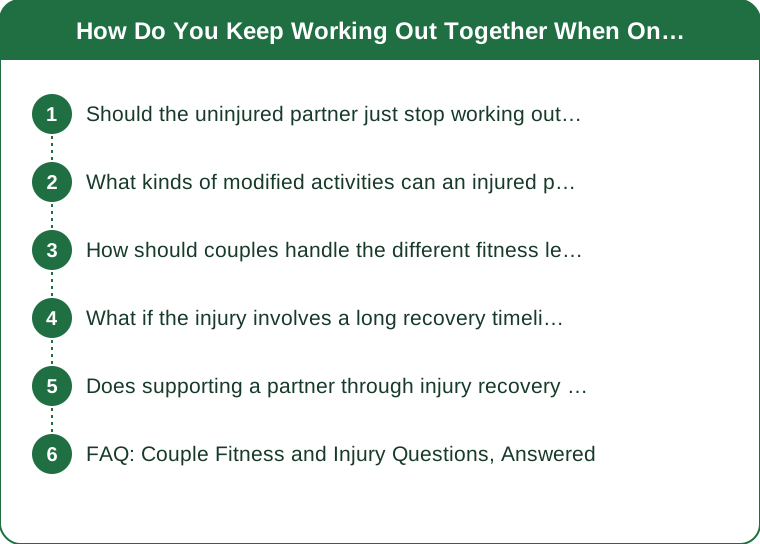
Should the uninjured partner just stop working out too, out of solidarity?
Generally not necessary, and often not helpful for either person. The uninjured partner pausing their own progress doesn’t speed the other’s recovery, and can create resentment or a loss of momentum that makes returning to shared workouts later feel harder. Continuing individual training while finding modified shared moments tends to work better.
What kinds of modified activities can an injured partner still do together?
This depends heavily on the specific injury, but common options include: walking alongside a partner’s run (if leg mobility allows), doing an upper-body-focused session together if the injury is lower-body, or simply being present during the other’s workout for company and conversation, even without matching the same exercise.
How should couples handle the different fitness levels that develop during recovery?
This is a temporary version of the general “different fitness levels” challenge many active couples face — clear communication about realistic expectations during the recovery window, and revisiting shared workout plans once the injury has healed, tends to work better than either partner assuming things will simply snap back to normal immediately.

What if the injury involves a long recovery timeline (months, not weeks)?
Longer recoveries benefit from setting a loose check-in point (“let’s reassess our shared routine in 6 weeks”) rather than an open-ended, undefined pause — this gives both partners a realistic horizon to plan around instead of an ambiguous, potentially frustrating waiting period.
Does supporting a partner through injury recovery affect the relationship beyond just fitness?
It can, in both positive and challenging ways. Some couples find that adapting together through an injury strengthens communication and patience; others find it surfaces underlying frustration if the fitness routine was a primary shared activity. Being explicit about needs and frustrations during this period, rather than assuming the other partner understands, generally leads to a better outcome.
FAQ: Couple Fitness and Injury Questions, Answered
Is it okay to feel frustrated about a shared routine being disrupted by a partner’s injury?
Yes — frustration about disrupted plans is a normal, human reaction and doesn’t mean you don’t care about your partner’s recovery; the key is expressing it constructively rather than letting it build into resentment.
Should the injured partner feel guilty about disrupting the couple’s routine?
Guilt is a common but generally unhelpful response to an injury that wasn’t a choice — reframing the situation as “temporarily different” rather than “broken” tends to reduce this guilt for both partners.
When is it appropriate to resume the exact pre-injury shared routine?
Only once the injured partner has full medical clearance for that specific activity — resuming based on how they feel alone, without clearance, risks re-injury and a longer overall disruption to shared fitness.
TL;DR:
- The uninjured partner continuing solo training doesn’t slow the other’s recovery
- Modified shared activities (walking alongside, upper-body-only sessions) maintain connection
- Setting a loose check-in point helps longer recoveries feel less open-ended
- Clear communication about frustration and expectations matters more than matching identical workouts
Working out “together” during an injury just needs a different definition for a while — connection matters more than doing the identical exercise.
Keep Reading
This article is for general informational and styling purposes only. Fit, sizing, and product availability may vary.