How Do We Restart Training Together After Months Off?
Quick Answer: Restarting together is harder than starting together, because you both carry the memory of the version that stopped — and you will each want to resume at a different point. The reliable approach is to rebuild frequency before intensity, agree explicitly on what a completed session looks like, and start with something neither of you did before, so nobody is measuring against their old numbers. Two short sessions a week that both of you attend beats four that one of you drags the other to.
The last time you trained together was some time in spring, and neither of you can quite say when it stopped.
Which means neither of you knows what starting again is supposed to look like.

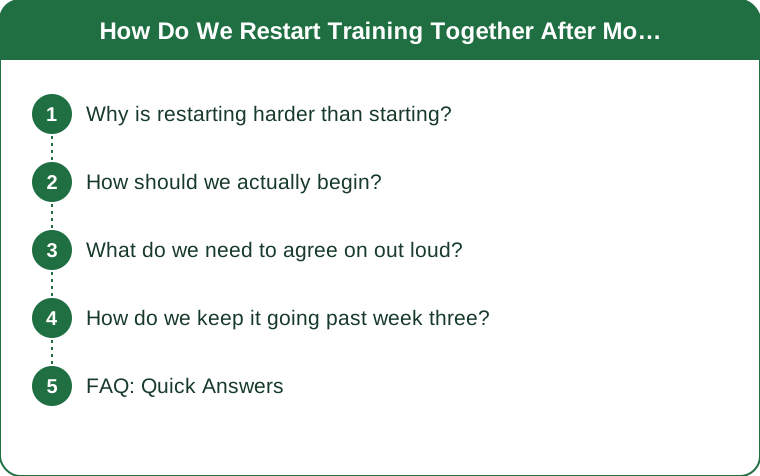
Why is restarting harder than starting?
Because you both remember the old version
When you started the first time, there was no benchmark. Now there is — the weights you used to lift, the pace you used to run, the four-days-a-week you used to manage. Every session gets silently compared to that, and the comparison is discouraging for both of you.
Worse, the memory is usually of the best version, not the average one. You remember the good month, not the ordinary weeks. Restarting against an idealised benchmark is a recipe for feeling like you have failed in week one.
Because you stopped for a reason
Something ended it — a busy period, an illness, travel, a change in schedule. If that reason still exists and neither of you names it, the restart will meet the same wall. This is the conversation most couples skip.
Because you are probably now at different points
Very often one partner kept doing something and the other did not. Even a small difference in maintained fitness becomes noticeable quickly, and the gap tends to be larger after a break than it was before.
Because the restart is usually one person’s idea
One of you wants this more right now. That is normal and it is fine, but if it stays unspoken, the more motivated partner ends up as the organiser, and being organised is a poor long-term motivator for the other one.
How should we actually begin?
What should the first month look like?
Frequency before intensity. Two sessions a week, both attended, for four weeks. That is the entire goal. Not progress, not weights, not a plan. Attendance.
This is the part couples find hardest to accept, because two easy sessions feels like it does not count. It does. The thing that broke last time was consistency, not intensity, and consistency is what you are rebuilding.
Should we do what we did before?
Preferably not, at first. Doing the old programme invites the old comparisons. Pick something neither of you did before — a class, a different style of training, a route you have not run, a routine from scratch. Novelty removes the benchmark, and it means you are both beginners at the same thing, which fixes the fitness gap problem for a few weeks.
How long should sessions be?
Shorter than you think. Thirty to forty minutes. The session you can both do on a bad evening is the session that survives, and long sessions are the first thing to be cancelled when something comes up.
What about the fitness gap between us?
Choose formats where it does not matter. Same exercises, different weights. Same route, different pace, meet at the end. A class where you are both following the instructor rather than each other. Avoid anything where one of you waits for the other — that is where resentment starts, on both sides.

What do we need to agree on out loud?
The definition of a completed session
Agree in advance what counts. This prevents the most common failure: one of you thinks a twenty-minute walk counts and the other thinks it does not, so one of you feels they are doing it and the other feels they are being let down.
Write down a normal version and a bad-day version. Both count. The bad-day version is what protects the streak through the week when something goes wrong, and it will.
Whether we are training together or separately-but-together
These are different things and both are valid. Training together means the same session, same room, same time. Separately-but-together means you each do your own thing and hold each other to showing up. Many couples do better with the second and never consider it, because the first is what “training together” is assumed to mean.
What happens when one of us misses
Decide now. The workable rule for most couples: the other person still goes. If one missed session cancels both, you have built a system where either person can end the week’s training unilaterally, and that is a fragile system.
Who is not coaching whom
The single most common source of friction. Unless one of you is actually a coach and the other has actually asked, nobody gives form feedback, nobody comments on effort, and nobody suggests a heavier weight. If you want feedback, ask for it explicitly, each time.
The reason it stopped last time
Name it, out loud, and decide what is different now. If nothing is different, plan for it — if the autumn schedule is what ended it, build the restart around that schedule rather than around the one you wish you had.
How do we keep it going past week three?
What usually breaks it?
Week three is where the novelty ends and the results have not arrived. This is well documented and it is worth expecting rather than being surprised by. The fix is to have decided your minimum session in advance, and to treat week three as the point where you deliberately do the easy version rather than skipping.
Should we add more once it is going?
Add a third session only after four consecutive weeks of two. Then hold that for another four. The instinct is to scale up as soon as it feels easy, and scaling up is what turns a sustainable habit into the thing that collapses in November.
How do we handle the schedule changing?
Anchor sessions to fixed points rather than to times. After dinner on Tuesday. Straight after work on Thursday. As evenings get darker and both of your schedules fill, a session anchored to an event survives where a session at 6.30pm does not.
Autumn also means outdoor evening options disappear. If your restart depends on it being light out, decide now what the indoor version is, before the week where it is dark and you have no plan.
What if one of us wants to stop again?
Say so early rather than quietly cancelling. A conversation about reducing to one session a week is much better than a slow fade to zero, and it usually results in something continuing. Most couples do not end training deliberately — it ends by attrition, and attrition is preventable by naming it.
FAQ: Quick Answers
Is it better to train together or just support each other?
Whichever you will actually do. The evidence for social support improving exercise adherence is strong; the evidence that it must be the same session is not. Two people who both train reliably and separately are doing better than two who train together twice and stop.
What if we have very different goals?
Different goals are compatible with the same session more often than people think — the same hour can contain one person’s strength work and the other’s conditioning. What is not compatible is one person’s session being dictated by the other’s goal.
How long until it feels normal again?
Most couples report the restart feeling awkward for two to three weeks and normal by week five or six. That is worth knowing in advance, because week two feeling hard is not a sign it is not working.
TL;DR:
- Restarting is harder than starting because you are both measuring against a remembered best version.
- Rebuild frequency first: two attended sessions a week for four weeks, thirty to forty minutes each.
- Do something neither of you did before, so nobody has old numbers to compare against.
- Agree out loud on what counts as a session, the bad-day version, what happens when one of you misses, and that nobody coaches anybody.
- Name why it stopped last time, and build around the schedule you actually have.
The couple still training in November will not be the one that restarted hardest. It will be the one that made the sessions small enough that both of them kept turning up.
Keep Reading
This article is for general informational and styling purposes only. Fit, sizing, and product availability may vary.