How Do We Train Together When We Do Not Live Together?
Quick Answer: Stop trying to share the training and share the structure instead. Couples in separate homes do best with one anchored joint session a week, individual programs the rest of the time, and a shared tracking method with a check-in rhythm rather than constant coordination. The failure mode is trying to coordinate every session, which produces cancellations and resentment. One reliable weekly session plus loose async accountability beats three fragile joint sessions.
You want to be the couple that trains together. You have three gyms between you, two commutes, and a calendar negotiation for every single session. Two weeks in, the plan has quietly collapsed and neither of you wants to be the one to say so.

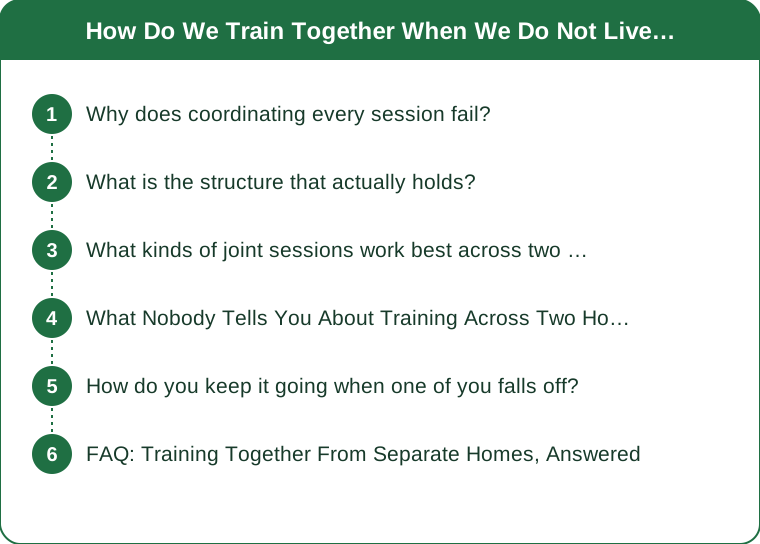
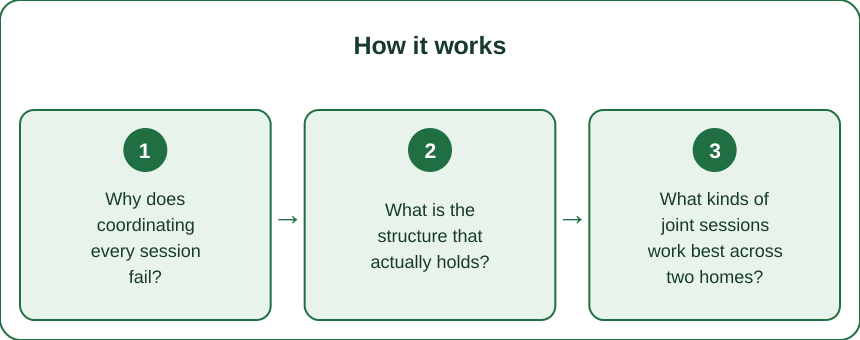
Why does coordinating every session fail?
Because each joint session needs two people to be free, motivated, and in the same place - and the probability multiplies. If each of you independently makes 80 percent of your planned sessions, the odds you both make the same one are about 64 percent. Add travel between homes and it drops further.
So joint sessions have a much higher cancellation rate than solo ones, and a cancelled joint session usually means neither of you trains, because the plan was the session.
Then there is the negotiation cost. Every session becomes a conversation - when, where, whose gym, who travels. That conversation is small, but doing it three times a week is genuinely draining and it is what people are actually quitting when they say it did not work out.
And it distorts the training itself. Meeting in the middle usually means whoever’s gym you are not at trains worse, and you end up doing a compromise workout that suits neither program.
What is the structure that actually holds?
One anchored joint session per week, same day and time, non-negotiable. Saturday morning, or Wednesday evening - it matters far less which than that it never moves. An anchored session needs no coordination and gets no negotiation.
Everything else is solo, on your own program, at your own gym. This is the part people resist and the part that makes it work. Your training does not need a partner; your consistency does.
Add one shared accountability channel. A simple shared note, a message thread, or a shared app where you both log that you trained. Not what you lifted - just that you went.
Add one weekly check-in that is not a workout. Five minutes on Sunday: what did each of you get done, what is next week’s plan, anything to adjust. This is the piece that carries the together part of training together.
And make the joint session about the relationship, not about the program. It should be the enjoyable one - a hike, a class, a long walk, doubles tennis. Your hard training sessions belong in your solo slots, where nobody is waiting for you between sets.
What kinds of joint sessions work best across two homes?
Things that need no equipment and no venue booking. A run or long walk from a midpoint. A park circuit. A hike on a weekend morning.
Classes you book together in advance. Booking converts a plan into a commitment with a small cost attached, which dramatically raises attendance. A class also removes the who leads question entirely.
Racquet and court sports. Tennis, padel, pickleball, badminton. These are genuinely better with two people, which is not true of most gym training, and the autumn court season is the best of the year.
Anything with a destination. A walk that ends at a coffee place, a route with a view. This is the version that survives a cold morning in November when a gym session would not.
What works badly: strength training together at different levels. Waiting through each other’s sets, adjusting weights constantly, and one person’s session being the other’s warm-up. Some couples enjoy it; most quietly stop.

What Nobody Tells You About Training Across Two Homes
The gym-bag problem is real and it kills more sessions than motivation does. Your kit is at your place and you are at theirs. Keep a full second set - shoes included - at their apartment, and have them do the same. This one logistical fix probably saves more sessions than any amount of accountability.
Sleeping at the other person’s place is a hidden variable. People train much less consistently on mornings after a night at their partner’s, because the routine and the equipment are somewhere else. Plan those mornings as rest days rather than as failed training days.
Avoid coaching each other unless explicitly invited. Unsolicited form advice from a partner lands differently than from a coach, and it is the single most common source of conflict in couple training. Ask do you want feedback or company today, and mean the question.
Different fitness levels matter less when you train separately. This is an underrated advantage of the separate-homes setup: nobody is holding anyone back, and the shared session can be chosen to suit both.
Autumn is when this arrangement gets tested. Darker evenings and colder mornings raise the cost of travelling across town to train together. Move the anchored session to daylight hours now, before the weather makes the decision for you.
How do you keep it going when one of you falls off?
Separate the accountability from the judgment. The shared log should record what happened without commentary. A partner who feels evaluated stops logging, and then you lose the signal entirely.
Treat a missed week as data, not as a failure. Ask what got in the way and adjust the structure, rather than restating the commitment. Usually the answer is a scheduling conflict that a small change would fix.
Do not compensate by increasing the joint sessions. The instinct when one person drops off is to schedule more together time. It usually makes it worse, because it raises coordination load on the person already struggling.
Keep the anchored session even if only one of you goes. The anchor is a fixed point in the week for both of you, and it survives much better if it is not conditional.
Revisit the arrangement every couple of months. Schedules change, seasons change, and a setup that worked in July may not survive November. Ten minutes of adjusting beats three weeks of quietly not training.
FAQ: Training Together From Separate Homes, Answered
Should we join the same gym?
Only if it is genuinely convenient for both of you. A shared gym that is convenient for one person and a 25-minute trip for the other produces exactly the same cancellation problem, plus a membership fee.
Do shared fitness apps and challenges help?
They help as a lightweight log and hurt when they turn into a competition, particularly if you have different fitness levels or goals. Use them for did you go, not for who did more.
What if one of us is much more into fitness than the other?
The separate-programs structure handles this better than any joint plan. The more committed person trains their own way, and the shared session is chosen to be genuinely enjoyable for the less committed one. Trying to bring someone along to your program is the most common way this goes wrong.
TL;DR:
- Coordinating every session multiplies two people’s cancellation rates and produces a plan that collapses in two weeks.
- Anchor one joint session a week at a fixed day and time, train solo the rest of the week, and keep a simple shared log plus one weekly check-in.
- Make the joint session the enjoyable one - a hike, a class, a court sport - and keep hard programmed training in your solo slots.
- Keep a full kit including shoes at each other’s places, treat post-sleepover mornings as rest days, and never coach unless asked.
You do not need to do the same workout to train together. You need one fixed point in the week and a way of knowing how the other one is doing. Everything else is logistics you can stop negotiating.
Keep Reading
This article is for general informational and styling purposes only. Fit, sizing, and product availability may vary.