Your Questions About Training Together on Shift Work, Answered
Quick Answer: Stop trying to train at the same time and redefine what training together means. Shared programme, shared tracking, and one or two genuinely joint sessions a month works far better than chasing simultaneous availability that does not exist. Protect the shift worker’s sleep above the workout, expect their capacity to vary hugely across a rota, and let the non-shift partner train independently without guilt. The goal is both of you training, not both of you training at the same moment.
The most common failure is treating a rota as a temporary obstacle. It is a permanent structure, and the plan needs to fit it rather than wait it out.

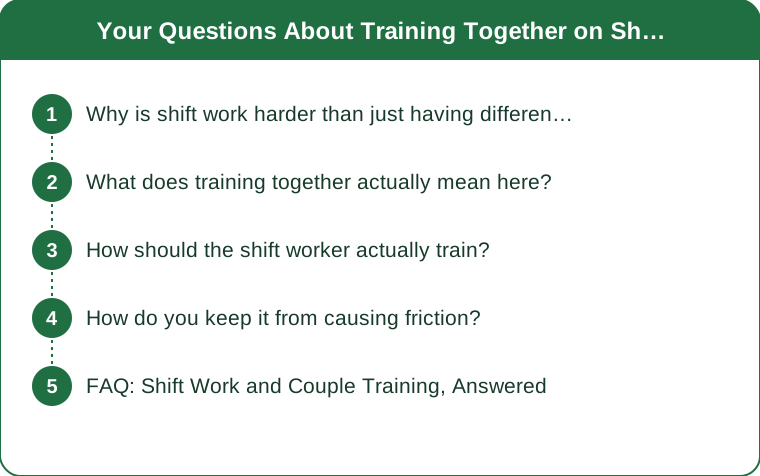
Why is shift work harder than just having different schedules?
It is not only when you are awake, it is how you feel
Two people with fixed but different schedules can find a stable overlap. A rotating rota means the overlap moves every week and there is no stable pattern to build a habit on. Habits need repetition at consistent times, and a rota removes that by design.
Circadian disruption affects performance genuinely
Shift work, particularly night work, disrupts the body clock. Strength, coordination, reaction time, and perceived effort all vary across the circadian cycle, and a shift worker training at the wrong point in their cycle is training at a real physiological disadvantage. This is not a motivation issue.
Sleep debt accumulates
Night shift sleep is frequently shorter and lower quality - daytime sleep is fragmented by light, noise, and the body clock working against it. Training on accumulated sleep debt produces poor sessions, slower recovery, and higher injury risk.
The rota affects the whole household
The non-shift partner is often absorbing more of the domestic load in shift weeks, which affects their available time and energy too. Both people’s capacity moves, in opposite directions, which is why this is harder than it looks from outside.
And the emotional layer
Shared time is scarce, so spending some of it on separate workouts can feel like a loss. That tension is real and worth naming rather than pretending training is purely logistical.
What does training together actually mean here?
Redefine it before you plan it
If together means simultaneous, this is unsolvable and you will keep failing at it. If together means shared purpose, shared programme, and shared attention, it is very solvable.
The shared programme model
Both of you follow the same programme, doing the same sessions on your own schedules. You compare notes, you know what the other is doing, and you progress together even though you train apart. This is the structure that works best for most shift-work couples and it requires no schedule overlap at all.
The shared tracking model
A shared note, spreadsheet, or app where both log sessions. It creates accountability and a sense of joint effort. The key is that it is visible to both of you and takes seconds, not that it is sophisticated.
The anchor session model
One genuinely joint session per rota cycle, planned in advance and treated as fixed. Once a fortnight or once a month is realistic. Because it is rare, it becomes the thing you look forward to rather than another obligation.
The active-together model
Instead of shared workouts, shared activity - a walk, a hike, a swim, cycling somewhere. Lower intensity, more talking, and it fits the days when the shift worker is depleted but not incapable. For many couples this is the most valuable part and it barely counts as training in either person’s programme.
What to avoid
Waiting for a better rota. Rotas do not improve, and the plan that depends on one starting is a plan that never starts.

How should the shift worker actually train?
Sleep comes first, always
If the choice is a workout or an hour of sleep during a night-shift block, take the sleep. Training on severe sleep debt produces little adaptation, increases injury risk, and worsens the recovery you already cannot afford. This should be an explicit agreement between you, not a decision made under guilt each time.
Match the training to the phase of the rota
Before a night block: normal training. This is when capacity is highest.
During a night block: reduce. Shorter sessions, lower intensity, more mobility and easy movement. Maintenance, not progression.
Recovery days after a block: very light or nothing for the first day. The priority is re-establishing sleep.
Days off in the middle of the cycle: the best training days. Put the hardest sessions here.
Train relative to waking, not to the clock
The useful rule is a few hours after waking, whenever waking happens. For a night worker that might be nine in the evening. That is a normal training time for their body even though it looks unusual.
Keep the minimum small
A twenty-minute session that reliably happens across a rota beats an hour that only happens on good weeks. Define the floor low enough that it survives the hardest part of the cycle.
Practical points
Eating patterns get disrupted on nights, so training fasted at three in the morning after a poor meal is a bad combination. And be conservative with heavy lifting on very low sleep - coordination and judgement are both affected.
This is general information, not medical advice. Persistent exhaustion, or sleep that does not improve on days off, is worth discussing with a doctor - shift work sleep disorder is a recognised condition.
How do you keep it from causing friction?
Agree the rules in advance, not in the moment
Decide together, on a good day, what happens when the shift worker is too tired. Having agreed that sleep wins means it is not renegotiated - and not resented - each time.
Do not make the non-shift partner wait
A common and damaging pattern is the non-shift partner putting their own training on hold to preserve the possibility of a joint session. That produces resentment and two people training less. They should train on their own schedule, freely.
Do not coach each other
This causes more conflict in couple training than scheduling ever does. Unsolicited form correction and comparisons of progress damage the relationship faster than they help the training. If one of you is much more experienced, share a programme rather than supervising.
Watch the comparison problem
On a shared programme, the shift worker will progress more slowly through periods of the rota. That is physiology, not effort, and it needs to be said out loud so it does not get read as commitment.
Protect the non-training time
If shared time is scarce, do not convert all of it into workouts. A shared session that displaces the only relaxed evening in a fortnight is a poor trade even if it is good training.
Autumn adds pressure
Darker evenings remove outdoor options that were absorbing some of this, particularly for the partner who trains around the shift worker’s sleep. Sorting out an indoor or well-lit alternative before the clocks change avoids losing several weeks discovering the problem.
Review the arrangement each rota cycle
What worked last month may not fit this one. Two minutes at the start of each cycle to look at the rota and plan the anchor session is far cheaper than a month of quiet friction.
FAQ: Shift Work and Couple Training, Answered
How can we train together when our schedules never overlap?
Redefine together as a shared programme and shared tracking rather than simultaneous sessions, plus one planned joint session per rota cycle. Chasing overlap that does not exist is what causes the whole thing to collapse.
Should my partner skip a workout to sleep after a night shift?
Yes. Training on significant sleep debt produces little adaptation and raises injury risk, and the sleep is the limiting factor. Agree this in advance so it is not a guilt-laden decision each time.
When is the best time for a shift worker to train?
A few hours after waking, whatever time that is. For a night worker that might be nine in the evening, which is physiologically normal for them even though it looks unusual from outside.
Should I put my own training on hold to match my partner’s rota?
No. That leads to two people training less and one of them resenting it. Train on your own schedule and use the shared programme and the planned anchor session as the connection.
How do we stop training causing arguments?
Do not coach each other - unsolicited correction and progress comparison cause more conflict than scheduling does. Agree the rules on a good day, and expect the shift worker to progress more slowly through parts of the rota for physiological reasons.
What if we only have one shared evening a fortnight?
Do not automatically convert it into a workout. A walk together counts as active time and preserves the evening. Shared low-intensity activity is often the most valuable part of this for a couple, and it costs the relationship nothing.
When should we get help?
If the shift worker is persistently exhausted, if sleep does not recover on days off, or if mood is affected over months. Shift work sleep disorder is recognised and treatable. This is general information, not medical advice.
TL;DR:
- A rota is a permanent structure, not a temporary obstacle. Build the plan around it.
- Redefine together as shared programme plus shared tracking plus one planned joint session per cycle.
- Sleep beats the workout during night blocks. Agree that in advance so it is not decided under guilt.
- Train a few hours after waking, whatever time that is - not at a fixed clock time.
- Put the hardest sessions on mid-cycle days off; reduce to maintenance during night blocks.
- The non-shift partner should train freely on their own schedule. Waiting produces resentment and less training.
- Do not coach each other. It causes more conflict than scheduling ever does.
- Shared walks count. Do not convert the only free evening in a fortnight into a workout.
Persistent exhaustion, or sleep that does not recover on days off, is worth raising with a doctor.
Keep Reading
This article is for general informational and styling purposes only. Fit, sizing, and product availability may vary.