Why Some Couples' Relationships Actually Improve When They Stop Working Out Together
Quick Answer: When partners have a meaningful fitness-level gap, a shared workout quietly becomes a performance comparison — and that structural mismatch, not the relationship, is usually what generates the friction. Training separately removes the comparison trigger while keeping the mutual support, which for these couples strengthens the relationship rather than weakening it.
You suggested running together because it sounded lovely. Time outdoors, a shared goal, the kind of thing couples in stock photos do while laughing.
Six weeks later, one of you is a hundred meters ahead pretending not to check over their shoulder, the other is doing math about how much longer this is going to take, and neither of you is talking on the drive home.
Nobody’s the villain here. The format is.

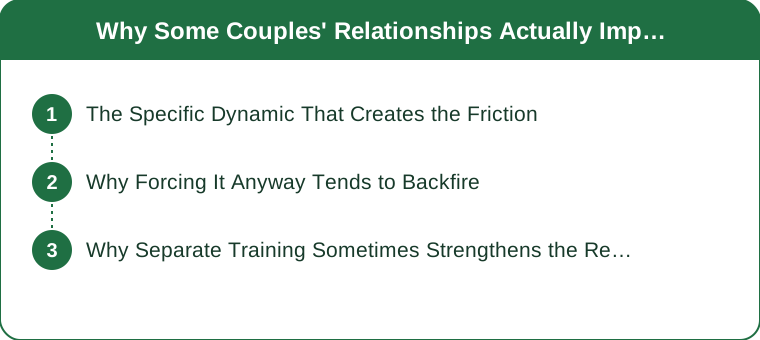
What Actually Causes the Friction in Couples’ Workouts?
A fitness-level gap turns a shared activity into an unspoken performance comparison.
That’s the whole mechanism, and it’s surprisingly mechanical. When one partner is meaningfully fitter — faster, stronger, more experienced, or simply further into a training habit — a joint session forces a constant negotiation that nobody agreed to:
- The faster partner either waits, holds back, or gets a workout that doesn’t challenge them. All three are quietly frustrating, and all three are hard to say out loud without sounding unkind.
- The slower partner is watching someone find easy what they’re finding hard, repeatedly, for forty-five minutes. That’s a difficult experience even in the most supportive relationship.
Neither person is doing anything wrong. The comparison is baked into the structure of doing the same thing side by side.
This matters because it’s the wrong diagnosis that causes the damage. Couples in this situation often conclude something is off between them — that one partner isn’t supportive enough, or the other isn’t trying hard enough. Usually the honest answer is far more boring: the activity format is mismatched, and the relationship is fine.

Why Does Forcing It Anyway Make Things Worse?
Because repetition attaches emotion to context, and the emotion here is the wrong one.
The whole point of the shared workout was to build connection. But if each session reliably generates the same low-grade tension — the waiting, the comparison, the slightly clipped conversation afterward — then over months you’re systematically training yourselves to associate frustration with time you deliberately set aside to be together.
That’s genuinely worse than not doing it. You started with neutral time and converted it into negative time.
It also tends to leak. A pattern that shows up three times a week doesn’t stay confined to the gym. It becomes a thing one of you mentions in a different argument, six weeks later, which is when it stops being about running.
The well-intentioned effort backfires specifically when the format keeps producing the same friction, session after session. Trying harder doesn’t fix a structural mismatch — it just runs it more often.
What Nobody Tells You About Training as a Couple
“Couples who train together stay together” is survivorship bias. You hear from the couples for whom it worked. The ones who quietly stopped after a month don’t post about it.
Shared activity and shared workout aren’t the same thing. Hiking, walking, cycling at a chatting pace, swimming in the same pool at different speeds — these are shared time without a performance axis. A tempo run is not.
The gap rarely closes. People often assume the mismatch is temporary and the slower partner will catch up. Sometimes true, frequently not — training history, genetics, injury history and available time all persist. Planning around a gap that closes is planning around a maybe.
Being coached by your partner is its own separate problem. Even when fitness levels match, one partner instructing the other adds a hierarchy that most relationships handle poorly. If you want coaching, hire someone whose feelings you don’t have to manage over dinner.
Separate training gives you something to talk about. Two people with their own thing bring news home. Two people doing the same session have already experienced it.
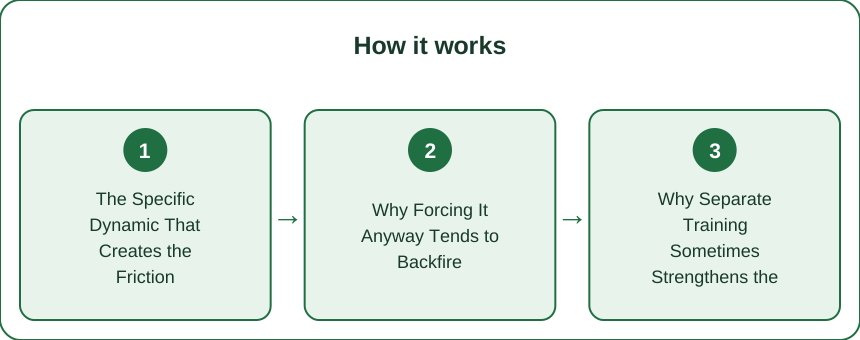
Why Does Training Separately Sometimes Work Better?
Because it removes the comparison trigger without removing anything that was actually valuable.
Here’s the thing the standard advice misses: mutual support for each other’s fitness doesn’t require being in the same room. You can enthusiastically back your partner’s training — protect their session time, ask how it went, celebrate the progress, handle the childcare on Thursday — from entirely outside it.
What you lose is the comparison. What you keep is the encouragement, the shared commitment to being active, and the household logistics that make both people’s training possible.
How to make the switch without it feeling like a rejection:
- Name the mechanism, not the person. “The pace difference makes this frustrating for both of us” lands very differently from “you’re too slow” or “you never wait.”
- Protect each other’s session times explicitly. Put them in a shared calendar. This is the concrete form support takes.
- Keep one genuinely shared activity with no performance axis — a weekend walk, a hike, a class you’re both new to.
- Ask how it went, and mean it. Two minutes of interest replaces forty-five minutes of friction, at a considerable profit.
- Same gym, different sessions is a legitimate middle ground. You travel together and train apart.
A caveat worth stating: this applies to a specific dynamic — a fitness gap generating friction in an otherwise healthy relationship. Plenty of couples train together happily, and if that’s you, nothing here suggests you should stop. If tension around exercise is part of a broader pattern involving control, criticism about appearance, or pressure around eating and body image, that’s a different situation. When to see a professional: persistent conflict that follows the same script regardless of context, or any dynamic involving control over a partner’s eating, exercise or appearance, is worth raising with a couples therapist or counselor rather than solving with a scheduling change.
FAQ
Is it bad for a relationship if couples don’t work out together?
No. Shared workouts are one way to spend time together, not a requirement for a healthy relationship. What matters is mutual support for each other’s goals, and that’s fully available whether or not you’re in the same room.
How do you tell your partner you’d rather train alone?
Frame it around the format rather than the person — the pace difference, the session structure, wanting to push harder or go easier without managing anyone else’s experience. Pair it with a concrete offer: protecting their training time, or keeping one shared activity that isn’t performance-based.
Can couples with different fitness levels ever train together?
Often, yes — if the activity has no performance axis. Walking, hiking, easy cycling, or being in the same gym doing different sessions all work well. The friction comes from doing the same effort side by side, not from being in the same place.
TL;DR
- The friction is structural, not relational. A fitness gap turns a shared session into an unspoken comparison.
- Forcing it repeatedly attaches frustration to time that was supposed to build connection.
- “Train together, stay together” is survivorship bias — you don’t hear from the couples it didn’t work for.
- Separate training removes the comparison and keeps the support. Those were always separable.
- Protect each other’s session times, keep one shared no-performance activity, and ask how it went.
- Don’t coach your partner. Hire someone whose feelings you don’t have to manage at dinner.
Keep Reading
This article is for general informational and styling purposes only. Fit, sizing, and product availability may vary.