What Do You Do When You and Your Partner's Fitness Levels Start Drifting Apart?
Quick Answer: When fitness levels drift apart, the most effective approach is decoupling ‘working out together’ from ‘working out at the exact same intensity’ — parallel training (same time, different intensity or activity) preserves the shared habit and connection without either partner holding the other back or feeling pushed.
You started working out together at a similar level, and now one of you has clearly progressed faster. That gap doesn’t have to mean giving up shared workouts — it usually just means changing what ‘together’ looks like.

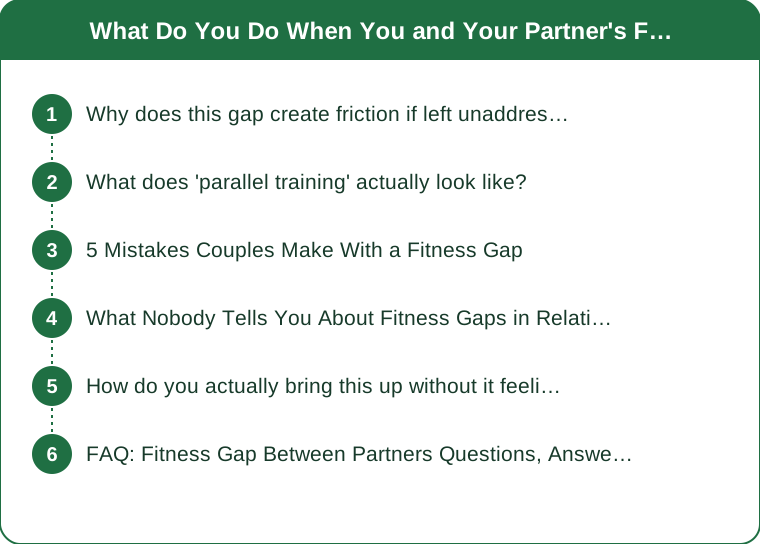
Why does this gap create friction if left unaddressed?
The faster-progressing partner may feel held back or bored scaling down to match, while the other may feel pressured, discouraged, or resentful trying to keep pace — both feelings are valid and tend to compound quietly if never actually discussed.
Left unaddressed, this often results in one partner quietly dropping shared workouts altogether, which loses the accountability and connection benefit that drew the couple to workout together in the first place.
What does ‘parallel training’ actually look like?
Same time and place, different program — one partner does their strength session while the other does cardio, or both do a strength session at their own individually appropriate weights and rest periods, finishing around the same time.
This preserves the shared ritual and accountability (showing up together, motivating each other) without forcing either person into an intensity that doesn’t match their current level.
5 Mistakes Couples Make With a Fitness Gap
1. The fitter partner slowing down so much it stops being a real workout for them, building quiet resentment over time.
2. The less-fit partner pushing to unsafe intensity trying to keep pace, risking injury.
3. Never actually discussing the gap directly, letting frustration build silently on both sides.
4. Framing it as a competition rather than two individual journeys happening in shared space.
5. Giving up shared workouts entirely instead of trying a parallel-training structure first.

What Nobody Tells You About Fitness Gaps in Relationships
The gap often isn’t permanent — motivation and life circumstances (work stress, injury, schedule changes) shift over time, and the partner currently ahead may not stay ahead indefinitely; treating it as a fixed hierarchy rather than a current snapshot reduces unnecessary tension.
Also underrated: non-workout shared activity (an active date, a hike, a walk) can maintain connection around fitness without either partner’s specific training level being relevant at all — it doesn’t all have to happen inside a structured workout.
How do you actually bring this up without it feeling like criticism?
Frame it around what you both want to preserve (time together, accountability) rather than the gap itself — ‘I want us to keep working out together, can we figure out a way that works for both our current levels’ lands very differently than commentary on the gap itself.
Check in periodically rather than assuming a single conversation permanently resolves it — fitness levels and feelings about the gap can shift, and revisiting the arrangement occasionally keeps it working for both people.
FAQ: Fitness Gap Between Partners Questions, Answered
Is it normal for couples to progress at different rates?
Yes, extremely common — different bodies, schedules, and starting points mean matched progression is the exception, not the rule.
Should we just work out completely separately if the gap gets big enough?
It’s an option, but many couples prefer parallel training specifically to preserve some shared time — full separation isn’t the only alternative to matched intensity.
What if my partner seems discouraged by the gap?
Acknowledge the feeling directly and consider shifting focus to their individual progress and non-comparative goals, rather than continuing to measure against your own pace.
TL;DR:
- A fitness gap between partners is common and doesn’t have to end shared workouts
- Parallel training (same time, different program) preserves connection without matching intensity
- Addressing the gap directly beats letting frustration build silently on either side
- The gap is often a current snapshot, not a permanent hierarchy — it can shift over time
Decouple ‘together’ from ‘identical’ and the friction usually resolves itself.
Keep Reading
This article is for general informational and styling purposes only. Fit, sizing, and product availability may vary.