What Do You Do When One Partner Is Way More Into Working Out Than the Other?
Quick Answer: A motivation gap between partners is best handled by decoupling ‘working out together’ from ‘working out at the same time and intensity’ — the more motivated partner keeps their own training goals intact while finding one or two lower-stakes shared activities the less motivated partner actually enjoys, rather than forcing a single shared routine that resents one person’s pace.
One of you wants to train five days a week. The other is happy with an occasional walk. Trying to force both of you into the same routine is usually where couple fitness plans quietly break down.

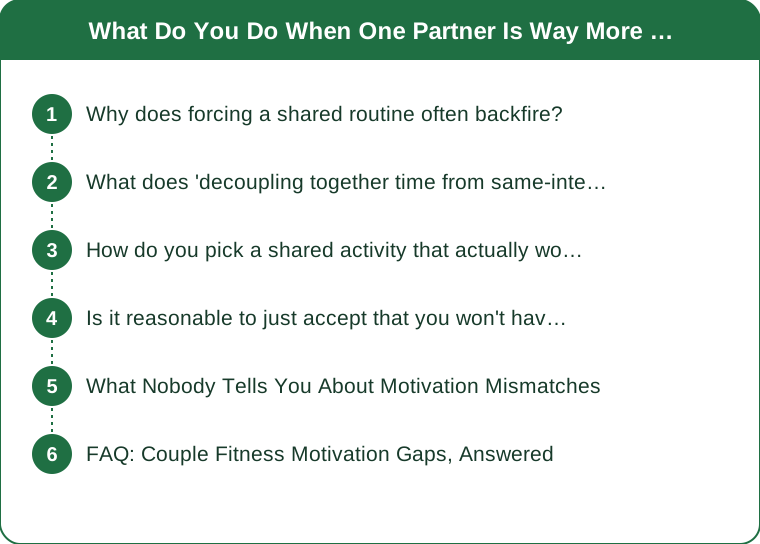
Why does forcing a shared routine often backfire?
When one partner is significantly more motivated, a forced shared routine tends to make the less motivated partner feel behind or inadequate, and the more motivated partner feel held back or resentful of a slower pace. Both outcomes erode the relationship benefit that shared fitness was supposed to provide in the first place.
What does ‘decoupling together time from same-intensity time’ actually look like?
It means the more motivated partner keeps their own individual training schedule intact — their runs, their lifting sessions, at their own pace — while both partners separately choose one or two lower-intensity shared activities, like a weekend walk or a casual bike ride, that don’t require matching fitness levels to enjoy together.
How do you pick a shared activity that actually works for a motivation gap?
Look for activities where intensity is naturally self-paced and success doesn’t depend on keeping up — walking, hiking, easy bike rides, or partner stretching sessions. Activities with a shared pace requirement, like running together or a class with a fixed intensity, tend to highlight the motivation gap rather than smooth over it.

Is it reasonable to just accept that you won’t have identical fitness routines?
Yes — for most couples, accepting different individual routines while sharing a smaller amount of lower-stakes joint activity produces a better long-term outcome than either partner sacrificing their own goals or forcing an uncomfortable match. Identical routines aren’t actually necessary for a relationship to get real benefit from shared activity.
What Nobody Tells You About Motivation Mismatches
The motivation gap is rarely really about fitness — it’s often about different relationships to structure, competitiveness, or free time, and treating it as purely a fitness scheduling problem misses the more useful conversation about what each partner actually wants their time together to feel like.
FAQ: Couple Fitness Motivation Gaps, Answered
Should the less motivated partner feel pressured to catch up?
No — sustainable motivation comes from within, and pressure from a partner tends to create resentment rather than lasting change.
Can occasional shared workouts still count as meaningful couple time even if they’re infrequent?
Yes, consistency of the relationship benefit matters more than frequency — even a weekly shared walk provides real connection value.
What if the less motivated partner actually wants to change but doesn’t know where to start?
Starting with something genuinely low-pressure and letting them set their own pace, rather than joining the more motivated partner’s existing routine, tends to work better.
TL;DR:
- Decouple ‘training together’ from ‘training at the same pace and intensity’
- Keep individual routines intact rather than forcing a single shared plan
- Pick self-paced shared activities like walking over intensity-matched ones
- The real issue is often about time and structure, not fitness itself
If a motivation gap has been quietly stressing your routine, try replacing the shared workout with a shared walk this week and see how differently it feels.
Keep Reading
This article is for general informational and styling purposes only. Fit, sizing, and product availability may vary.