How to Work Out With a Much Fitter Partner Without Feeling Left Behind
Quick Answer: Structure joint workouts around shared time and effort level, not shared exercises — same workout duration, each person at their own appropriate intensity or modification, works far better long-term than forcing identical reps and weights.
One of you finishes the set with breath to spare; the other is gasping by rep 6. If that gap has quietly stopped your joint workouts altogether, the fix isn’t matching fitness levels — it’s matching the framework instead.

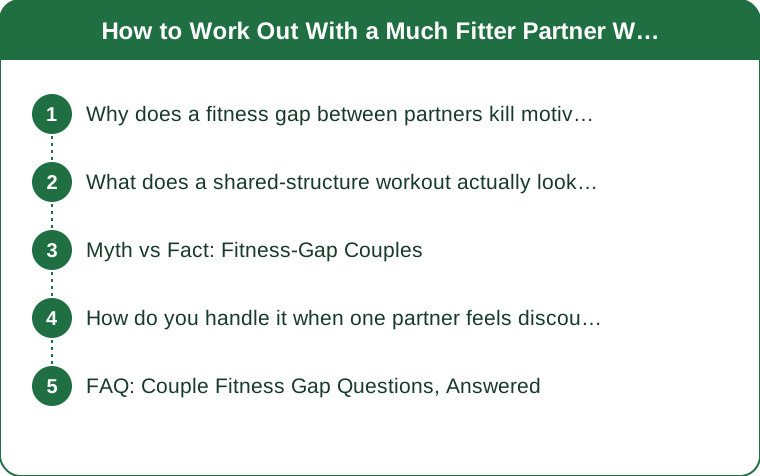
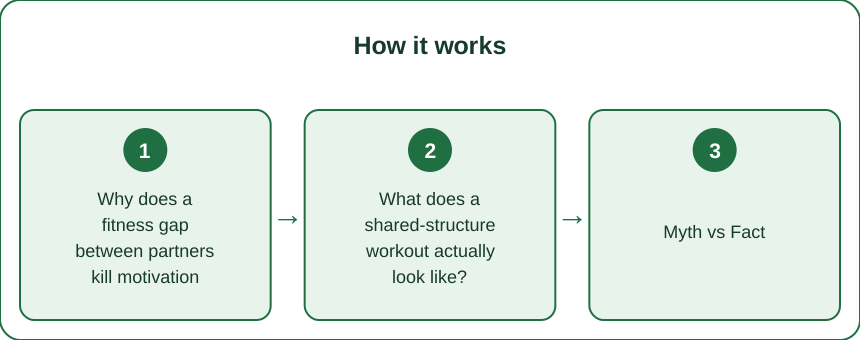
Why does a fitness gap between partners kill motivation to train together?
Because most couples default to doing the exact same exercises and loads, which forces one person to either hold back (frustrating for them) or push the other beyond a safe, enjoyable intensity (discouraging for them). The workout becomes about closing a gap instead of shared time, and that framing burns out fast.
The fix is training with the same structure — same warm-up, same total time, same number of exercises — while each person selects their own appropriate weight, rep count, or modification.
What does a shared-structure workout actually look like?
Pick a format both of you follow, but personalize the load:
- Same circuit, different weights or reps — e.g., both do squats, one at bodyweight, one with added load
- Same time-based intervals — 40 seconds work, 20 seconds rest, regardless of how many reps each person completes in that window
- Same warm-up and cool-down together, splitting only for the main work block if fitness gaps are large
This keeps the shared experience (starting and finishing together) without forcing identical output.

Myth vs Fact: Fitness-Gap Couples
Myth: The fitter partner should always scale down to match. Fact: Constant scaling down long-term often causes resentment or stalled progress for the fitter partner — better to adjust load, not effort or challenge.
Myth: Working out together only works if you’re evenly matched. Fact: Time-based, self-paced formats work regardless of the gap size — the format matters more than the fitness match.
Myth: A big gap means you should just train separately. Fact: Separate training is a valid choice, but many couples specifically value the accountability and connection of shared time — a smart format preserves that without the frustration.
How do you handle it when one partner feels discouraged mid-workout?
Build in a check-in moment, not just silent parallel effort — a quick ‘how’s this feeling’ between rounds normalizes different experiences of the same workout. Framing progress individually (comparing your own week 1 to week 4, not comparing to your partner) also reduces the comparison trap that causes most of the discouragement.
FAQ: Couple Fitness Gap Questions, Answered
Should we ever do fully separate workouts?
Yes, occasionally — a mix of joint time-based sessions and some independent training covers both connection and individual progress goals.
How do we choose weights fairly in a shared circuit?
Each person picks a weight where the last 2 reps of a set feel genuinely challenging — that’s a fair personal calibration regardless of the actual number.
What if my partner gets competitive and pushes too hard to keep up?
Name it directly and reset to the time-based, self-paced format — competitiveness usually fades once the structure removes the direct comparison.
TL;DR:
- Match the structure (time, format), not the exact reps or weight
- Time-based intervals let both partners work at their own edge simultaneously
- Check in mid-workout instead of assuming silent effort feels the same for both
- Occasional separate training plus joint time-based sessions covers both goals
The goal was never identical performance — it was showing up together. A shared structure protects that even with a real fitness gap.
Keep Reading
This article is for general informational and styling purposes only. Fit, sizing, and product availability may vary.