Training Together When Autumn Schedules Stop Lining Up, Answered
Quick Answer: Most couples lose their shared training routine in September because the schedule that made it possible disappears, not because motivation drops. The approaches that survive are decoupling the time from the activity, protecting one shared session a week rather than defending all of them, and accepting asynchronous training as the default rather than as a failure.
All summer you trained together four times a week and it was easy.
Three weeks into September you have managed it once, and it has started to feel like a relationship problem.
It is a scheduling problem, and it responds to scheduling solutions.

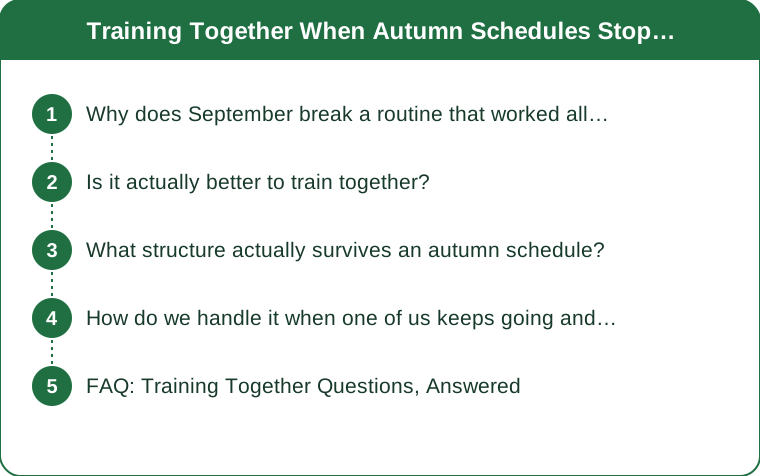
Why does September break a routine that worked all summer?
Because summer routines are built on flexibility that no longer exists, and neither person has fewer constraints than before — they have differently shaped ones.
Three specific things change:
Fixed points reappear and they do not align. Work resumes properly, term starts, clubs and classes restart. If one of you now has a fixed Tuesday commitment and the other has a fixed Thursday one, the overlap that existed in August is gone. It is not that either of you is busier in total — the free hours no longer coincide.
Daylight shrinks the shared window. A 7pm outdoor session in July is a 7pm dark session in October. Couples who trained outdoors together lose the format itself, not just the timing.
Household load increases. School runs, admin, and evening logistics all return, and the person absorbing more of that has a genuinely different amount of discretionary time than they did in July.
The result is that a couple who both still want to train together find the shared slot has simply disappeared, and then interpret the resulting friction as a motivation or commitment issue.
Naming it as a calendar problem rather than a willingness problem changes the conversation entirely, and usually removes most of the tension in it.
Is it actually better to train together?
Sometimes, and it depends on which benefit you are after — being clear about this prevents a lot of unnecessary compromise.
Where training together genuinely helps:
- Accountability, which is real and well supported. Being expected somewhere raises attendance meaningfully.
- Shared time, which for many couples is the actual point. The training is a vehicle for spending an hour together.
- Logistics, particularly childcare — one session for two people is simpler than two sessions.
Where it works against you:
- Mismatched training goals. If one is training for a distance event and the other for strength, a shared session serves neither well and both end up compromising.
- Mismatched fitness levels. One person constantly waiting, the other constantly stretched. Manageable in some formats and corrosive in others.
- Mismatched preferred timing. Forcing a morning person into evening sessions produces worse training and resentment.
The useful question is: which of the three benefits do you actually want? If it is shared time, the activity matters less than you think and a walk counts. If it is accountability, you do not need to be in the same room — you need to know the other person will ask. If it is logistics, the answer is a schedule problem with a schedule solution.
Most couples default to assuming they need all three from every session, and that is what makes autumn feel like a failure.

What structure actually survives an autumn schedule?
A one-plus-many structure, rather than trying to preserve four shared sessions.
Protect exactly one genuinely shared session a week. One is defensible. Four is not, and defending four means all of them feel fragile. Put it in a calendar as a fixed commitment and treat it like any other appointment.
Make the rest asynchronous but connected. Train separately at the times that suit each of you, and keep the connection through a shared log, a message after each session, or a weekly total. The accountability effect largely survives without co-location.
Pick the shared session for the format that works for two. A walk, a hike, a class, a swim. Something where different fitness levels do not create a problem. Do not make the shared session the hard specific training either of you needs — that one should be solo.
Use the weekend for the shared slot if weekdays have collapsed. Saturday morning is the single most protectable time in most autumn schedules.
Trade explicitly rather than implicitly. You take Tuesday, I take Thursday, and each of us covers the household side on the other’s day. Stated out loud, this works. Assumed silently, it produces resentment within about a fortnight.
Have a fallback for the shared session. If it is outdoors and it is dark and raining, what replaces it? Deciding in advance is what stops one cancelled session becoming a stopped routine.
How do we handle it when one of us keeps going and the other stops?
This is the most common autumn pattern in couples, and it is worth handling deliberately because it can turn into a genuine source of friction.
Separate the two questions. Whether your partner is training and whether they are okay are different questions, and merging them makes both harder to discuss. A drop-off in September is often about workload or sleep rather than about the training itself.
Do not use your own consistency as leverage. It rarely produces training and reliably produces defensiveness. The person who has stopped almost always knows they have stopped.
Offer the smallest possible version. Not a return to the four-session routine — a twenty-minute walk on Sunday. Restarting is much easier from something tiny than from a reinstated full programme.
Ask what would make it possible rather than why it stopped. The first question is practical and gets useful answers. The second is retrospective and gets excuses.
Take on a logistics piece if that is the actual barrier. Frequently the person who stopped is the one absorbing more of the household increase, and no amount of encouragement addresses that. An hour of covered childcare is worth more than any conversation about motivation.
Accept different seasons. People go through periods of training more and less, and a partner who trains three times a week in autumn and once in December has not failed. Long-term consistency across years looks lumpy, and treating every dip as a problem to solve makes the dips worse.
FAQ: Training Together Questions, Answered
Should we follow the same programme?
Only if you have similar goals and similar training ages. Otherwise, share the schedule rather than the programme — same time, same place, different work. This solves most mismatch problems at once.
What if one of us is much fitter?
Choose formats where that does not matter: hiking where the fitter person carries more, intervals where you each work to your own effort, or classes where everyone scales. Avoid formats where one person is simply waiting.
Is it a bad sign if we stop training together?
Not by itself. It is usually a calendar artefact of September, and it typically recovers by late October once the new routine settles. If shared time in general has disappeared rather than just training, that is a different and more worthwhile conversation.
TL;DR:
- September breaks shared routines because fixed commitments no longer overlap, not because commitment dropped
- Decide which benefit you actually want: accountability, shared time, or logistics — they have different solutions
- Protect one shared session a week rather than trying to defend four
- Make the shared session a format that tolerates different fitness levels, and keep hard specific training solo
- Trade schedule and household coverage explicitly rather than assuming
- If one person stops, offer the smallest possible version and address logistics rather than motivation
The four-session summer routine was made possible by a schedule that no longer exists. One protected session plus asynchronous training for the rest is not a downgrade — it is the version that survives to spring.
Keep Reading
This article is for general informational and styling purposes only. Fit, sizing, and product availability may vary.