How Do We Train Together Without One of Us Coaching the Other?
Quick Answer: Agree explicitly, before the first session, that neither of you gives feedback unless it’s asked for. The coaching dynamic is the single most common reason couple training generates friction, because it converts a peer activity into a hierarchy - and it lands differently from a partner than from a coach. Train in parallel rather than as instructor and student: same time and place, separate programmes, shared warm-up and finish. Ask for feedback explicitly when you want it, and keep the actual coaching to a professional if either of you wants real technical input.
One of you has trained for years. The other is starting. Within three sessions somebody says your back’s rounding and something in the room changes.

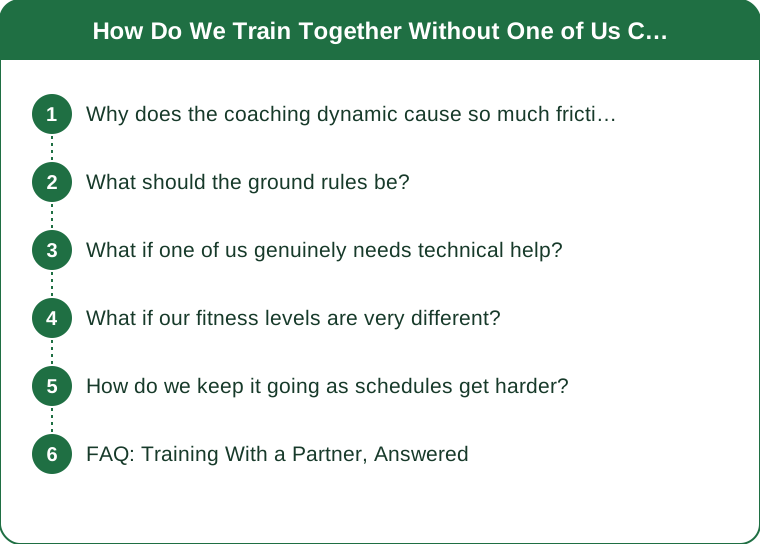
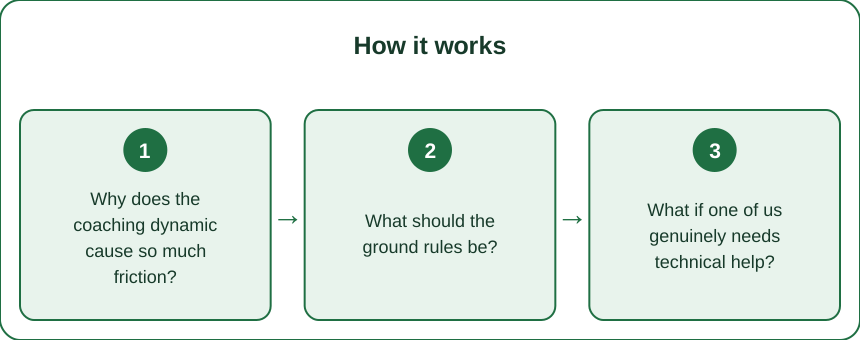
Why does the coaching dynamic cause so much friction?
It converts a peer relationship into a hierarchy. Even accurate, well-intended feedback establishes one person as the expert and the other as the learner, and that role difference doesn’t stay in the gym.
Feedback from a partner carries extra weight. A coach’s correction is a technical observation. The same words from someone you live with can land as criticism, because the relationship gives them a history the coach’s words don’t have.
The more experienced partner usually can’t see the problem. From their side it’s helpful information freely given. From the other side it’s being observed and evaluated during something they already feel uncertain about.
Beginners are self-conscious enough already. Starting to train is uncomfortable, and being watched by someone whose opinion matters enormously makes it more so, not less.
It shifts the reason for training. Once one person is coaching, the session is partly about performance for an audience rather than about doing the work - and that reliably reduces how much either of you wants to go.
And it’s asymmetric in a way that compounds. The coaching partner gets a normal session; the coached partner gets a session plus an evaluation. Over weeks, that difference in experience is what quietly ends the arrangement.
What should the ground rules be?
No feedback unless it’s requested. Say it out loud, once, before you start. An explicit agreement is far more effective than an assumption, and it gives the less experienced partner a rule to point at rather than a conversation to have.
Define how to ask. Something specific - can you watch this set? - so that requested feedback is unambiguous and welcome when it happens.
Agree that safety is the exception. If something looks genuinely dangerous, say so. Everyone accepts this, and naming it in advance stops it being used to smuggle in general coaching.
Train in parallel rather than together. Same time, same place, separate programmes. You get the company and the shared habit without the instructor dynamic.
Share only the warm-up and the finish. Ten minutes at each end together, individual work in the middle. It’s the format that most reliably survives, because the shared part has no performance component.
And revisit the rules if it’s going wrong. A short honest conversation outside the gym beats an accumulating resentment inside it. The rule can change - it just shouldn’t change silently.
What if one of us genuinely needs technical help?
Get a few sessions with an actual coach. It’s the cleanest solution, it removes the dynamic entirely, and a handful of sessions covers the fundamentals for most people.
Use video instead of a person. Filming a set and watching it back gives you the same information without anyone watching in real time. It’s how a lot of experienced lifters self-correct.
Let the experienced partner write the programme, not deliver it. Programme design is a one-off contribution that doesn’t require standing over someone. Delivery is where the friction lives.
Ask for one specific thing per session. Bounded requests - just watch my hip position on this set - are much easier for both people than open-ended observation.
Set a time limit on technical conversation. Five minutes at the end, not a running commentary. Confining it stops it expanding to fill the session.
And accept that beginners get to be imperfect. Most technique flaws in early training aren’t dangerous and improve with practice. Correcting everything immediately slows learning and makes the whole thing joyless.

What if our fitness levels are very different?
Use the same structure with different loads. Same exercises, same sets, different weights or variations. You’re doing the same session without either of you compromising.
Pick activities where the gap matters less. Walking, hiking, cycling on flat routes, swimming in separate lanes, classes. Gaps in strength are stark; gaps in a shared walk are barely relevant.
Let the less experienced person set the pace on shared work. It’s a simple rule and it prevents the most common resentment - one person consistently working at the wrong intensity to accommodate the other.
Do separate sessions for anything competitive. If one of you is training for something, that training belongs on its own rather than being adapted into a shared session.
Don’t compare numbers, ever. Different bodies, different histories, different training ages. Comparison is the second most common source of couple training conflict after coaching.
And accept that separate training is a valid outcome. Plenty of couples train better apart and are happier for it. Training together isn’t a relationship requirement, and forcing it produces exactly the friction it was meant to avoid.
How do we keep it going as schedules get harder?
Anchor it to a fixed slot you both protect. Two sessions a week at a set time survives autumn schedule changes far better than a flexible arrangement.
Have a short version you both accept. Twenty minutes at home when the evening collapses. Couples usually fail together, so a shared low bar keeps both of you going.
Plan for the dark evenings now. Whatever you did outdoors together is about to get harder. Deciding the indoor version in advance prevents the gap where the habit dies.
Let one person carry it some weeks. If one of you is struggling, the other going anyway keeps the slot alive rather than both dropping out - which is how these arrangements usually end.
Notice what you both actually enjoy. The version that persists is the one you’d choose to do, not the one that’s optimal on paper.
And separate the relationship conversation from the training conversation. If training is generating recurring conflict, that’s worth talking about over dinner rather than mid-set. This is general information, not medical advice - and if either of you is returning from injury or a health condition, individual professional guidance beats a partner’s programme.
FAQ: Training With a Partner, Answered
How do we stop my partner correcting my form?
Agree explicitly, before a session, that neither of you gives feedback unless it’s asked for, with safety as the only exception. An explicit rule is far easier to hold to than an unspoken expectation.
Should couples do the same workout?
Same structure with different loads works well; identical sessions rarely do when fitness levels differ. Training in parallel - same time and place, separate programmes - avoids most of the friction.
What if one of us is much fitter?
Use activities where the gap matters less, let the less experienced person set the pace on anything shared, and keep competitive or event-specific training as separate sessions.
Is it better to train separately?
For plenty of couples, yes. Training together isn’t a relationship requirement, and separate sessions plus a shared walk or class often produces more consistency and less conflict than forcing a joint programme.
TL;DR:
- Agree explicitly that neither partner gives feedback unless asked, with safety as the only exception.
- The coaching dynamic converts a peer activity into a hierarchy, and it lands differently from a partner than from a coach.
- Train in parallel - same time and place, separate programmes, shared warm-up and finish.
- If real technical input is wanted, use a few coach sessions or video rather than a partner watching in real time.
- Never compare numbers, let the less experienced person set shared pace, and accept separate training as a valid outcome.
The person offering the correction is almost always trying to help. That’s exactly why the rule has to be agreed in advance rather than negotiated mid-set.
Keep Reading
This article is for general informational and styling purposes only. Fit, sizing, and product availability may vary.