How Do We Train Together When Our Schedules Stop Matching?
Quick Answer: When schedules stop overlapping, the fix is usually to separate the shared part from the training part. Keep one genuinely shared session a week and let the rest happen independently, rather than trying to preserve a joint routine that no longer has a joint window. Couples who insist on training together at all costs typically end up training less.
The autumn schedule change tends to remove exactly the window two people had in common, and the routine that survived all summer stops within a fortnight.

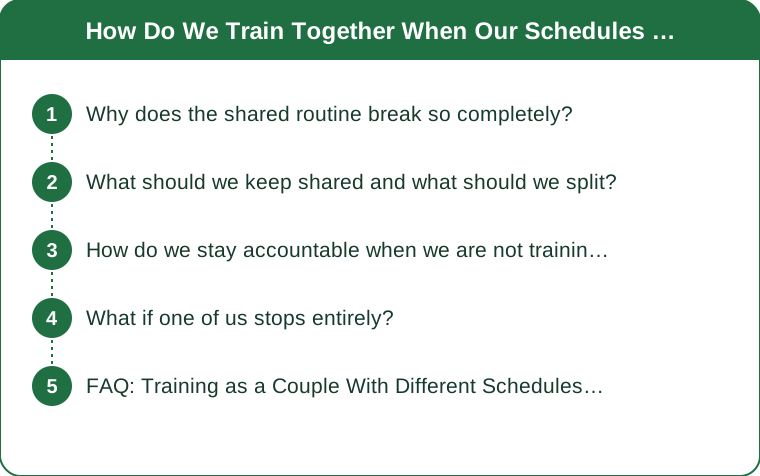
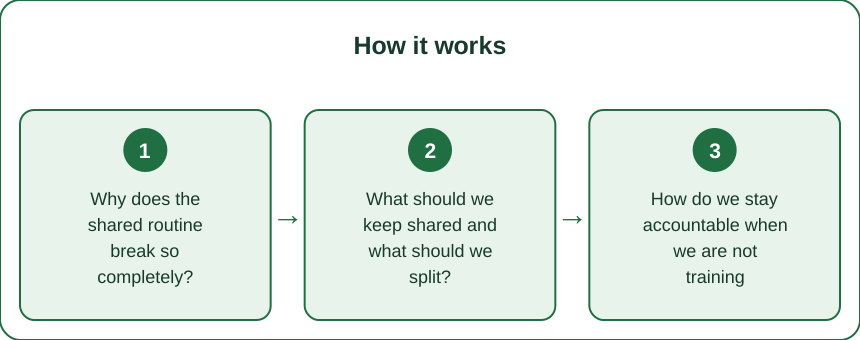
Why does the shared routine break so completely?
Because a shared routine depends on the intersection of two schedules, and intersections shrink much faster than either schedule changes.
The arithmetic is unforgiving. If each person’s available windows shrink by 30 percent, the overlap can shrink by considerably more than that - two people each losing a couple of slots can lose their only common one entirely.
What typically changes in September:
- Term times, commuting patterns, and evening commitments for one or both people
- Childcare and school schedules, which reshape the whole evening
- Earlier darkness, which removes outdoor evening options
Why it feels like a bigger loss than a solo routine breaking: the sessions were partly social. You are losing time together as well as training, which is why couples often keep trying to force a joint schedule that no longer exists rather than adapting.
The reframe that helps: separate the two things the routine was providing.
- Training - which needs consistency and can happen independently
- Time together - which needs a shared window and does not have to be exercise
Once separated, both are easier to solve. The training moves to whenever each person can do it, and the shared time gets protected as its own item rather than being smuggled inside a workout.
What should we keep shared and what should we split?
The general answer: keep one shared session with a low bar, and split everything that needs to be consistent.
Keep shared - one weekly anchor session:
- A weekend walk, hike, swim or bike ride rather than a structured gym session
- Low intensity, so it works regardless of what either person did that week
- Longer and more social, since it is doing the relationship job as well as the movement one
- Protected in the calendar like an appointment, because it is the item that will otherwise disappear
Split - the sessions that need to happen consistently:
- Strength training, which needs a schedule that fits each person’s actual week
- Anything goal-specific, where the two of you have different targets anyway
- Anything where the fitness gap makes joint training frustrating for both
Why splitting the structured sessions often improves things:
- Each person trains at their own intensity rather than at a compromise that suits neither
- Sessions stop being contingent on two people being free, which is the main failure mode
- The shared session stays enjoyable rather than becoming the place where one person is bored and the other is struggling
On the fitness gap specifically: training together works well when the gap is small or when the session is structured to accommodate it - same exercises at different loads, or a run where one person does intervals and the other runs steady on the same loop. It works badly when one person is consistently either held back or left behind, and the resentment builds quietly.
A structure that works for many couples: two or three independent sessions each, plus one shared weekend activity. The independent sessions do the training; the shared one does the rest.

How do we stay accountable when we are not training together?
Shared accountability survives separation better than shared scheduling does.
What works:
- A shared visible record. A whiteboard, a shared note, a simple app - seeing that the other person trained is most of the accountability effect, and it does not require being in the same room.
- A weekly check-in of two minutes. What did you do, what is the plan for next week. Short and routine beats occasional and detailed.
- Shared goals with independent execution - a joint step target, a race you are both entering, a number of sessions per month between you
- Covering for each other. The most practical form of support in a couple is taking the childcare or the household task that makes the other person’s session possible. This is worth more than any amount of encouragement.
What does not work:
- Monitoring or chasing. Accountability that feels like supervision produces resistance, and it changes the dynamic in a way that is hard to reverse.
- Comparing progress. Different bodies, different schedules, different starting points. Comparison is where couple training goes wrong most often.
- One person managing both people’s routines, which is a load that eventually gets resented by both
On the person who is less motivated: the most effective thing a partner can do is remove friction rather than add pressure - handling the logistics, making the time available, going for the shared walk. Pushing reliably backfires, and the research on autonomous versus controlled motivation is fairly consistent that externally pressured exercise does not sustain.
On the person who is more motivated: be careful about making your routine the household’s organising principle. The shared session should be enjoyable for both, which sometimes means it is easier than you would choose.
What if one of us stops entirely?
It happens most autumns, and the response matters more than the lapse.
First, check the actual cause. People stop for structural reasons far more often than motivational ones:
- The window genuinely disappeared and has not been replaced
- The commute or the childcare changed and nobody rebuilt around it
- They are exhausted, which is a sleep and load problem rather than a discipline one
- The sessions stopped being enjoyable, often because they were designed around the other person
What tends to help:
- Rebuild around a new anchor rather than reinstating the old time
- Reduce the size dramatically. Twenty minutes twice a week that happens beats an hour three times that does not.
- Offer the logistics, specifically and concretely - ‘I will take Tuesday mornings so you can go’ works; ‘you should go more’ does not
- Keep the shared session going regardless, because it maintains the connection to activity even when the independent training has stopped
What does not help:
- Framing it as a discipline failure, which adds a relationship cost to what was a scheduling problem
- Signing them up for something, which removes autonomy and rarely sticks
- Escalating your own training in response, which increases the gap and the pressure
On the underlying point: exercise sustains best when it is autonomously motivated. A partner can make it easier, more social and more convenient, and cannot supply the motivation. The most useful role is reducing friction and keeping the door open.
If either of you has a persistent drop in energy, mood or motivation that lasts more than a couple of weeks, that is worth a conversation with a healthcare professional rather than a training solution. This is general information, not medical advice.
FAQ: Training as a Couple With Different Schedules, Answered
Should we keep trying to train together?
Keep one shared low-intensity session a week and split the structured training. Insisting on joint scheduling for everything usually means both people train less.
What if we are at very different fitness levels?
Shared sessions work best when they are social and low intensity, or structured so each person works at their own level on the same loop. Compromise intensity tends to satisfy neither person.
How do we stay accountable apart?
A shared visible record and a two-minute weekly check-in. Practical support - taking the childcare that makes the session possible - is worth more than encouragement.
My partner has stopped completely. What should I do?
Check whether the cause is structural rather than motivational, offer specific logistical help, and keep the shared session going. Pressure reliably backfires.
Is training together actually good for a relationship?
Shared activity generally is, but the mechanism is the time together rather than the exercise. That is precisely why the shared session should prioritise being enjoyable over being effective.
TL;DR:
- Overlapping windows shrink much faster than individual schedules do
- Separate the two jobs the routine was doing: training and time together
- Keep one low-intensity shared session weekly, split everything that needs consistency
- Practical support - taking the task that frees the hour - beats encouragement every time
- Pressure backfires; removing friction is the only reliably useful thing a partner can do
The shared routine did not fail because either of you lost interest. The window closed. Protect one session for the relationship and let the training find its own times.
Keep Reading
This article is for general informational and styling purposes only. Fit, sizing, and product availability may vary.