How Do We Train Together When One of Us Has a Race Coming Up?
Quick Answer: Stop trying to share every session and start sharing the right ones. In any structured plan, roughly 70 to 80 percent of the volume is easy work - and easy sessions are the ones that genuinely work for two people at different levels, because the trained partner is supposed to be going slowly. Protect the two or three key sessions a week as solo, non-negotiable, and put the shared time into easy runs, warm-ups, strength work, and the long session’s early miles. Agree the plan before the block starts, including what happens in taper week and on race day, because that is where the resentment usually accumulates.
The problem is not the training. It is that one of you now has a calendar that outranks everything else, and nobody discussed it.

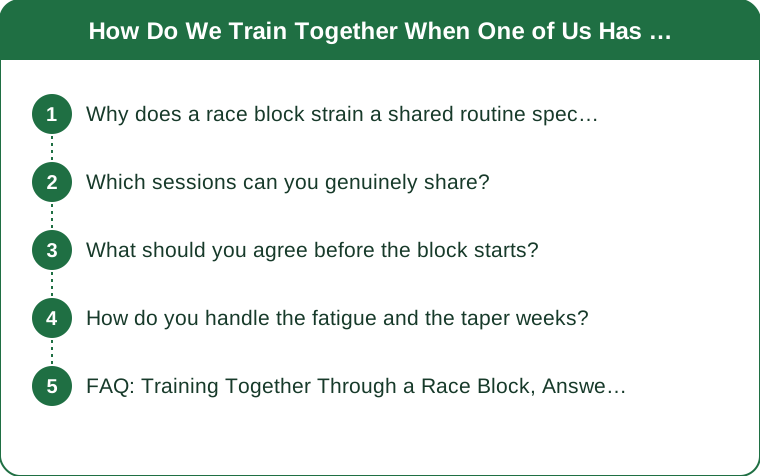
Why does a race block strain a shared routine specifically?
Because it changes the nature of the commitment, not just the volume.
Before the block, workouts were negotiable. Skip a Tuesday, move Saturday, do a shorter version. Both people had equal say and the cost of changing was low.
During a block, sessions have a role. A tempo run on Wednesday is not interchangeable with an easy run on Thursday - the plan has a structure and moving pieces around degrades it. Suddenly one person’s schedule is rigid and justified, and the other’s is flexible by default. That asymmetry is felt long before anyone names it.
Three specific pressure points:
1. Time. A marathon block can mean 6 to 10 hours of training a week, plus recovery, plus the fatigue that reduces energy for everything else. That comes out of shared time, household time, and social time, and it accumulates over 12 to 18 weeks.
2. Identity. The training partner has a goal, a plan, a community, and a countdown. The other partner has none of those and can end up as support crew for a project they did not choose. This is the most common unspoken grievance and it rarely surfaces as itself - it surfaces as an argument about Saturday.
3. Fatigue. Late in a block, the trained partner is tired, less socially available, and going to bed early. That is not a relationship problem but it looks exactly like one from the outside.
The reframe that helps: a race block is a temporary, mutual project with a defined end date, or it is a solo project the other person is absorbing costs for. Which one it becomes is decided by whether it is discussed in week zero or week nine.
Which sessions can you genuinely share?
More than most couples assume, once you sort by intensity rather than by activity.
Shareable - these work well:
- Easy and recovery runs. In most endurance plans, the large majority of running is deliberately easy. The trained partner is supposed to be running slowly, and having company is one of the better ways to enforce that - going too fast on easy days is the single most common self-sabotage in endurance training. A less-trained partner is an excellent pacing brake.
- The first portion of a long run. Run the first 5 to 8km together, then split - one continues, one turns back or loops home. This gets you the companionable part of a long session without either person compromising.
- Warm-ups and cool-downs. Fifteen minutes at each end, several times a week, adds up.
- Strength sessions. Two people can do the same movements at completely different loads with no compromise whatsoever. This is the most underrated shared session and it benefits the racer directly.
- Mobility, stretching, and rehab work, which nobody does consistently alone.
- Walks. Genuinely valuable recovery for the racer, genuinely good exercise for the other, and the best conversation of the week.
Not shareable - protect these:
- Interval and threshold sessions. These require specific paces and specific recoveries. Trying to do them together degrades them for the trained partner and is unpleasant for the other.
- The final third of long runs, where the specific fatigue is the point.
- Race-pace work.
The cycling and swimming version: the same logic applies but the mechanics differ. Cycling shares more easily because drafting equalises effort substantially - a stronger rider on the front makes a shared ride genuinely feasible. Swimming shares poorly for pace but well for a shared session in adjacent lanes.
The practical arithmetic: in a 6-session week, roughly 4 are easy or strength. You can share most of the week and still protect every key session, which is a much better outcome than the all-or-nothing framing most couples default to.

What should you agree before the block starts?
Have this conversation once, in week zero, and it prevents most of the friction. It takes twenty minutes.
1. The actual time cost, in hours. Not sessions - hours, including travel and showering. Write it down. Most people underestimate by 30 to 40 percent, and the surprise is what causes resentment rather than the number itself.
2. Which sessions are non-negotiable and which can move. Typically two or three key sessions are fixed and the rest are flexible. Saying this explicitly means the flexible ones can genuinely be moved for the relationship without it being a concession every time.
3. What the other person gets. This is the step everyone skips. Protected time that is not training - a standing evening, a weekend morning that is not consumed by a long run, a trip that is planned around. If one person’s calendar gains a large claim, the other’s should gain something too.
4. The long-run day. This is the biggest single intrusion in most plans - three or four hours out of a weekend day, plus a tired afternoon. Agree which day, agree what happens afterwards, and consider whether an early start protects the rest of the day.
5. Taper and race weekend. Taper often makes people irritable and restless, which is worth predicting rather than being surprised by. And decide what the non-racing partner’s role is on race day - spectating for five hours in the cold is a real contribution, and it should be a choice rather than an assumption.
6. What happens after. The post-race gap is genuinely common - a training block gives structure and purpose, and its removal leaves a hole. Planning something shared for the two weeks after the race is a small step that prevents a strange flat period.
7. The honest question: does the non-racing partner want a goal too? Sometimes the answer is a shorter event on the same day, which turns a solo project into a shared one. Sometimes it is emphatically no, and that is equally fine - but asking makes the difference between a supporter and a bystander.
How do you handle the fatigue and the taper weeks?
Weeks 1 to 4 - the easy part. Volume is manageable, enthusiasm is high, and shared sessions are easy to maintain. Use this period to establish the habits you will need later, because they will not form under fatigue.
Weeks 5 to 10 - peak load, and where problems appear.
- The trained partner is genuinely tired. This is physiological, not emotional withdrawal, and naming it prevents it being read as the latter.
- Shared easy sessions matter most here and are the first thing dropped. Keeping the Sunday walk and the twice-weekly strength session is worth more than it appears.
- Watch for the training becoming the only topic. A useful rule some couples use: talk about the block for ten minutes and then move on.
- Practical support is more valuable than encouragement at this stage - food, an early night, taking something off the list.
Taper - the strange weeks. Volume drops sharply and the trained partner often feels restless, irritable, oddly heavy, and convinced they have lost fitness. All of that is normal. The upside: there is suddenly time again, and using it deliberately rather than letting it be absorbed by anxiety is a good move. Taper is an excellent window for the shared things that were squeezed out.
Race week. Low volume, high nerves, and often poor sleep the night before. The most useful support is logistical and calm rather than motivational.
After the race. Recovery takes longer than most people expect - typically one easy day per mile raced is a rough rule for a marathon, meaning weeks rather than days. Expect a mood dip. Plan something to look forward to that is not training, and agree whether the next block is happening before either person assumes it is.
The recurring version: if this is the third block in two years, the conversation is different. At that point the pattern is the relationship’s normal, and it is worth asking honestly whether the balance still works for both people rather than renegotiating each time.
FAQ: Training Together Through a Race Block, Answered
Should I just train for the same race?
Only if you actually want to. Doing it to preserve shared time frequently produces an under-prepared, resentful second racer. A shorter distance at the same event is often the better version - shared journey, shared day, appropriate goal.
Is it bad for the racer to run easy runs with a slower partner?
Usually the opposite. Most people run easy days too fast, and a slower partner enforces the intended pace. It only becomes a problem if the shared pace is so slow it changes running mechanics substantially, in which case a walk or a bike alongside works better.
How do we handle it when the long run eats every Saturday?
Agree on an early start, agree what the rest of the day looks like, and rotate which weekend day it falls on if the plan allows. The predictability matters more than the hours.
My partner is training and I feel left behind. Is that unreasonable?
It is extremely common and worth saying out loud early rather than at week ten. The usual fix is not less training - it is protected shared time that does not depend on training, plus a goal of your own if you want one.
What if the race does not go well?
Expect a difficult few days. The most helpful response is generally to let it be disappointing rather than immediately reframing it, and to have something already planned for the following week.
TL;DR:
- 70 to 80 percent of a training block is easy work - and easy sessions are exactly the ones two people at different levels can genuinely share.
- Protect the two or three key sessions as solo, share easy runs, warm-ups, strength work, and the first half of the long run.
- Have the week-zero conversation: hours not sessions, which sessions are fixed, what the non-racing partner gets, the long-run day, taper, race day, and after.
- Peak weeks bring real physiological fatigue. Name it, keep the shared walk and strength session, and lead with practical support.
- Plan for the post-race gap, and decide together whether there is a next block rather than assuming.
The race is not the problem. One calendar quietly outranking the other, without anyone agreeing to it, is.
Keep Reading
This article is for general informational and styling purposes only. Fit, sizing, and product availability may vary.