Couple Workouts When Your Fitness Levels Do Not Match
Quick Answer: Stop trying to do the same workout - share the session instead. Interval formats where each person moves at their own pace, station circuits with scalable moves, effort-based challenges, and the fitter partner carrying a loaded pack on shared walks all deliver a real workout to both of you side by side. Add the ground rules - no unsolicited coaching, effort counts not pace, both keep some solo sessions - and the gap stops being a problem and starts being logistics.
The fantasy is the matching-outfit couple crushing the same workout in sync. The reality in most households is a fitness gap - different training ages, different sports histories, different bodies - and the couples who actually train together long-term are not the matched ones. They are the ones who solved the design problem the matched couples never had to face.

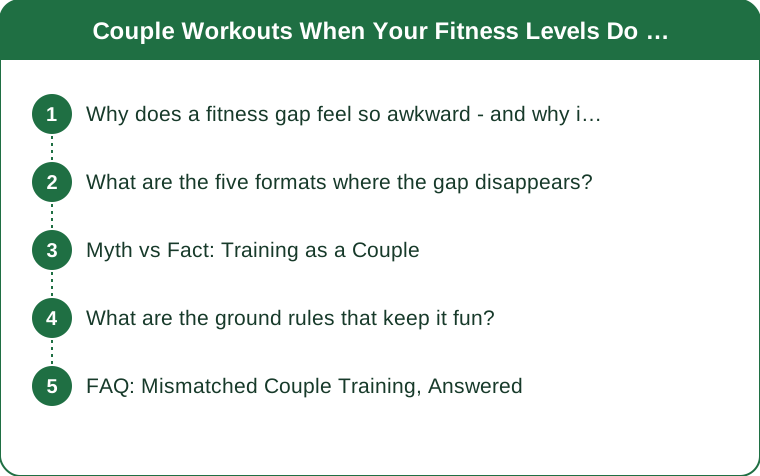
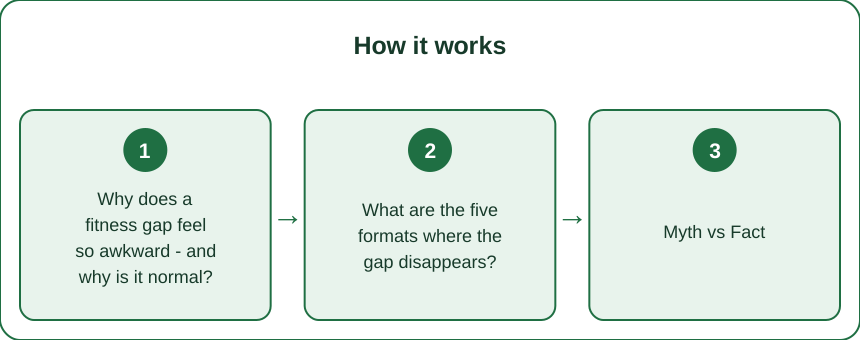
Why does a fitness gap feel so awkward - and why is it normal?
Because shared workouts accidentally turn a difference into a comparison, and comparisons poison exercise fast.
Gaps are the default, not the exception. Training age - years of consistent exercise - varies enormously between partners, and it matters more than raw athleticism. Add different sports backgrounds, different bodies, different jobs and injury histories, and two people at identical fitness levels are the coincidence, not the norm.
The same workout mis-doses both people. Exercise works by challenging your current capacity - and one workout cannot sit at two capacities at once. Run at the fitter partner’s pace and one person is redlining while the other is barely warming up; run at the other pace and reverse the problem. One session, two wrong doses, and the post-workout moods to match: one frustrated at being held back, one demoralized at holding someone back. Neither of those feelings is a character flaw - they are the predictable output of a bad format.
And couples add feelings to physiology. A stranger dropping you on a hill is forgettable; a partner doing it lands differently. The demoralized partner starts declining invitations, the fitter one starts training alone resentfully, and the couple concludes they are not workout compatible - when the truth is they never tried a format designed for a gap.
The reframe that fixes everything downstream: togetherness is the shared session, not the identical workout. Same place, same time, same finish-line high-five - individually dosed work in between. Every format that works is built on that one idea.
What are the five formats where the gap disappears?
1. Own-pace intervals, shared clock. Same start line, same work-and-rest structure - 60 seconds hard, 90 easy, repeated - each at your own all-out. A track, a hill, bikes, a pool: you are genuinely training together, finishing intervals within seconds of each other, and the stopwatch never once compares your distances. This is the cleanest format there is, because intensity is personal by definition.
2. Station circuits with scaling. Set up four to six stations - squat variation, push variation, row or band pull, carry, core - and rotate on a timer. Every station has an easier and harder version standing next to each other: incline push-ups beside floor push-ups, bodyweight squats beside loaded ones. Same circuit, same music, same suffering schedule, individually scaled load.
3. AMRAP with personal scorecards. Set fifteen minutes, each person cycles their own version of the moves, counting personal rounds - competing against your own last score, never each other’s. The shared timer creates the event; the personal scorecard removes the comparison.
4. The loaded handicap walk or hike. The oldest trick and still the best for conversation-based training: the fitter partner carries the weighted backpack - and rucking is a legitimately excellent workout in its own right, not a consolation prize. Adjust the load until both of you are honestly working at a conversational-but-real effort on the hills. Bonus: the couple that talks for 50 minutes of hills has done relationship work and cardio simultaneously.
5. Shared bookends, separate middles. Warm up together, train apart in the same gym or park - each on your own program - reconvene for ten minutes of stretching and the cooldown debrief. On paper it barely counts as a couple workout; in practice it delivers everything people actually wanted from one: company, accountability, and a shared ending, minus every dosing problem.

Myth vs Fact: Training as a Couple
Myth: The fitter partner has to sacrifice their training to work out together. Fact: Only in identical-workout formats. Own-pace intervals and scaled circuits let the fitter partner train at full honest intensity - and the handicap walk literally adds load until it is real training. Format design, not sacrifice, is the answer.
Myth: A little competition keeps it fun. Fact: For evenly matched pairs, sometimes. Across a real gap, competition rewards the head start and demoralizes the chaser - effort-based and self-referenced scoring keeps the fun without the fixed outcome. Compete against your own last score, not each other.
Myth: The less-fit partner should just push harder to catch up. Fact: Adaptation runs on consistent, appropriate dosing over months - not on redlining beside someone with five years of base. Chasing a partner’s pace is the classic route to injury and quitting; the gap closes through their own progression, not through borrowed intensity.
Myth: Coaching your partner is supportive. Fact: Unsolicited form corrections from a partner land as criticism almost regardless of intent, and the coach-partner dynamic sours sessions faster than any burpee. Share workouts, not instructions - and outsource technique to videos, classes, or an actual trainer.
Myth: Couples who do not train together are missing something. Fact: Parallel schedules - both training, separately, and comparing notes at dinner - are a complete and thriving version of a fit couple. Together is one format among several, not the gold standard.
What are the ground rules that keep it fun?
Formats handle the physiology; rules handle the feelings. Agree these before the first shared session, not after the first argument.
No coaching unless asked. The single most protective rule in couple fitness. Encouragement is always welcome; technique commentary waits for an explicit invitation. One sentence each, agreed in advance, covers it.
Effort is the shared currency. The session succeeded if both people worked honestly at their own level - pace, load, and rounds are personal statistics, not standings. Debrief in effort language: that felt like an eight, not you were slow.
Alternate the architect. Take turns designing the shared session. The runner plans intervals one week; the partner who loves the trail picks the hike the next. Both calendars get their favorite, and both people learn the other’s world - which was sort of the point of all this.
Protect the solo sessions. Each partner keeps at least one workout a week that is entirely theirs - the fitter one’s hard session, the newer one’s no-audience practice space. Couple training works best as an addition to two individual routines, not a merger of them.
Celebrate separately, together. Her first unbroken mile and your hundredth are different mountains climbed the same week - both get dinner-table billing, neither gets converted into the other’s units.
And keep the gear talk generous too: one of you lifts in worn shorts, the other lives in buttery-soft leggings and matching sets, and the handicap-walk uniform is whatever survives the hill - a couple that treats each other’s fitness cultures as equally legitimate has already won the only comparison that matters.
FAQ: Mismatched Couple Training, Answered
How do couples work out together with different fitness levels?
Share the structure, not the workload: own-pace intervals on a shared clock, scaled station circuits, personal-score AMRAPs, and walks where the fitter partner carries a loaded pack. Same session, individually correct doses.
Should I slow down to my partner’s pace?
For a recovery walk, happily. For real training, no - pick formats where both of you work at honest intensity simultaneously instead of one of you donating the session. Slowing down every time breeds quiet resentment in both directions.
Is it OK that my partner never wants to train with me?
Completely. Parallel fitness - separate workouts, shared dinner-table debriefs - is a fully successful version of an active couple. Invite, do not conscript, and let one shared walk a week be plenty.
How does the less fit partner catch up?
Through their own consistent, progressive program over months - not by chasing the fitter partner’s sessions. The gap narrows fastest when both people are correctly dosed, which is exactly what the shared-structure formats provide.
TL;DR:
- A fitness gap is the norm, and identical workouts mis-dose both partners - share the session, not the workload.
- The five formats: own-pace intervals, scaled circuits, personal-score AMRAPs, the loaded handicap walk, and shared bookends with separate middles.
- Ground rules: no unsolicited coaching, effort is the only shared metric, alternate who designs the day, protect solo sessions.
- The gap closes through the newer partner’s own progression - never through chasing.
The couple goal was never matching splits. It was ending up sweaty and laughing in the same parking lot - and that one is fully available at any two fitness levels.
Keep Reading
This article is for general informational and styling purposes only. Fit, sizing, and product availability may vary.