What to Actually Do When You and Your Partner Can Never Find a Workout Time That Works for Both of You
Quick Answer: When a fully shared workout schedule genuinely doesn’t fit both partners’ calendars, shifting the goal from ‘workout together every session’ to ‘workout together on a realistic subset of days, separately on the rest’ tends to sustain the relationship-fitness benefit far better than repeatedly failing to coordinate a joint schedule and eventually dropping it altogether.
Every attempt to build a shared workout routine has quietly died at the scheduling stage — one of you has an early call, the other has a late shift, and ‘we’ll figure it out’ never quite happens. There’s a more realistic structure than an all-or-nothing shared schedule.

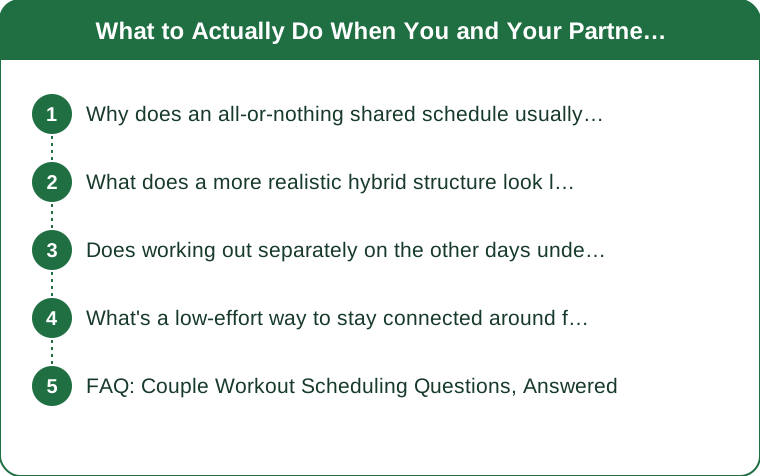
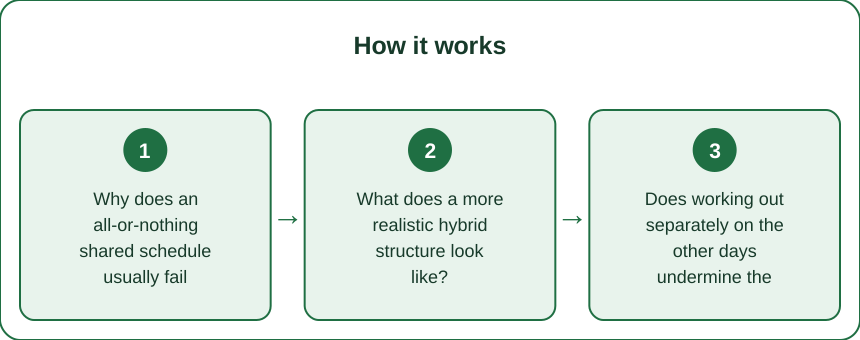
Why does an all-or-nothing shared schedule usually fail first?
Because it depends on both calendars aligning consistently, which is a fragile requirement — a single conflicting week can break the whole routine’s momentum, and rebuilding a habit from scratch after a break is harder than maintaining a more flexible structure that never fully depended on constant alignment.
What does a more realistic hybrid structure look like?
Picking 2-3 realistic joint session days (weekends or a specific weekday both calendars reliably allow) and treating the remaining workout days as independent, individual sessions removes the pressure of daily coordination while still preserving the shared-activity benefit on the days it’s actually feasible.

Does working out separately on the other days undermine the relationship benefit?
Not significantly — research on couples and shared activity generally points to quality and consistency of shared time, not total volume of joint activity, as the more relevant factor. A few reliable joint sessions a week can deliver much of the connection benefit without requiring every session to be shared.
What’s a low-effort way to stay connected around fitness on solo workout days?
A quick check-in — sharing a workout summary via text, or a two-minute conversation about how each session went — maintains a sense of shared progress on the days you’re not training together, without requiring the actual sessions to overlap.
FAQ: Couple Workout Scheduling Questions, Answered
Is it worth using a shared calendar app specifically for this?
Yes — a shared calendar for workout availability, updated weekly, removes a lot of the ‘figuring it out’ friction that causes scheduling attempts to quietly stall.
What if joint sessions consistently fall through even on the agreed days?
That’s worth a direct conversation about whether the agreed days are actually realistic, rather than continuing to schedule around a day that consistently doesn’t work — adjusting the plan is more useful than repeating the same failed attempt.
Does this approach work for couples with very different fitness levels too?
Yes — separate sessions on non-joint days also solve the different-fitness-level problem, since each partner can train at their own pace independently while still sharing the joint sessions.
TL;DR:
- An all-or-nothing shared schedule is fragile and breaks easily with a single conflicting week
- Picking 2-3 realistic joint session days, with independent training the rest of the week, is more sustainable
- Quality and consistency of shared time matters more than total joint workout volume
- A quick check-in on solo days maintains connection without requiring every session to overlap
A more flexible structure tends to actually survive real schedules better than an ambitious fully-shared plan that keeps quietly failing.
Keep Reading
This article is for general informational and styling purposes only. Fit, sizing, and product availability may vary.