When You Want to Build Muscle and Your Partner Wants Cardio: Every Question Answered
Quick Answer: Different fitness goals can coexist in shared workout time through structured formats like circuit training (alternating strength and cardio stations) or simply training in the same space at the same time on different programs — togetherness doesn’t require identical workouts.
One of you wants to build muscle, the other wants to run further. That mismatch feels like it means separate gym trips forever, but it doesn’t have to.

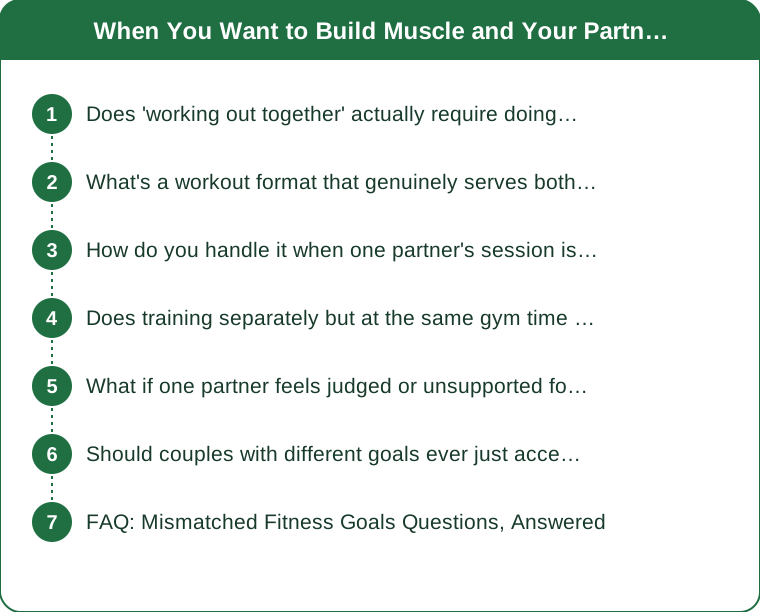
Does ‘working out together’ actually require doing the same exercises?
No — shared time and space matters more for the relationship benefit than identical exercises, and many couples find that training side-by-side on different programs (one lifting, one on a treadmill nearby) delivers the connection and accountability benefit without either person compromising their actual goal.
What’s a workout format that genuinely serves both goals at once?
Circuit-style training — alternating a strength station and a cardio burst (like 45 seconds of squats followed by 45 seconds of jump rope) — gives both partners exposure to their preferred training style within the same session, even if one person weights the ratio more toward strength and the other more toward cardio.
How do you handle it when one partner’s session is much longer than the other’s?
Structuring a shared warm-up and shared finisher, with the middle portion split into individual, goal-specific work, respects both time needs without forcing one person to cut their session short or the other to pad theirs unnecessarily.

Does training separately but at the same gym time still count as ‘together’?
For most couples, yes — arriving and leaving together, being in the same space, and comparing notes afterward provides much of the accountability and connection benefit that couples actually value, even when the actual exercises performed are completely different.
What if one partner feels judged or unsupported for their different goal?
This usually points to a communication gap rather than an unsolvable structural problem — explicitly agreeing that different goals are equally valid, and avoiding commentary on the other’s chosen training style, prevents the goal mismatch from becoming a source of tension.
Should couples with different goals ever just accept training completely apart?
It’s a legitimate option, not a failure — if shared workout time consistently creates friction rather than connection, training separately and connecting around fitness in other ways (meal planning together, celebrating each other’s progress) can work just as well for the relationship.
FAQ: Mismatched Fitness Goals Questions, Answered
Can a couple with different goals still use the same gym membership or app?
Yes — shared logistics (gym membership, scheduling) work independently of whether the actual training content matches.
How often should couples with different goals actually train together in the same session?
There’s no fixed number — some couples do shared circuit sessions 2-3 times weekly and train solo the rest of the week; the right frequency depends on what actually feels supportive rather than obligatory.
Does one partner’s goal eventually need to ‘win’ for compatibility long-term?
No — many long-term couples maintain different primary goals indefinitely without it causing ongoing conflict, as long as both partners feel their goal is respected.
TL;DR:
- Shared workout time doesn’t require identical exercises
- Circuit-style training with alternating strength and cardio stations serves both goals at once
- Shared warm-up and finisher, split individual middle, respects different time needs
- Training in the same space on different programs still delivers most togetherness benefits
- Different goals don’t need to converge — mutual respect matters more than matching programs
Keep Reading
This article is for general informational and styling purposes only. Fit, sizing, and product availability may vary.